Showing posts with label gluten-free. Show all posts

Friday, December 06, 2024

Diets Recommended for Chronic Illness: Paleo, Keto, Carnivore


I finally edited and uploaded my video on the three diets most often recommended for ME/CFS, long-COVID, and other immune disorders: paleo, keto, and carnivore diets.

The video describes each of these three different diet options in detail, including what each entails, how they can benefit someone with chronic illness, and lots of ideas on what kinds of foods to eat, with plenty of suggestions for meals, snacks, and recipes. All three of these diets are often recommended for a wide variety of medical conditions, including immune disorders like ME/CFS and long-COVID, autoimmune disease, and any health problem that involves inflammation. They are all low in inflammatory foods, low in foods likely to exacerbate food allergies or intolerances (which are very common in ME/CFS and long-COVID), and good for those with yeast overgrowth (also very common in ME/CFS due to our specific kind of immune dysfunction). Surprisingly, these diets are also very tasty, with a wide variety of flavors, and are easier and less work than a traditional diet.

We have tried all three and have seen benefits in reduced symptoms, increased energy, and better control of yeast overgrowth. We ate paleo for about a decade or so, and I wrote a detailed blog post about the paleo diet, if you prefer to read about it. However, as I explained in the video, I now know it was a mistake to make exceptions to it, so ignore the modifications I talk about in the post! When I have more energy, I'll update that. It worked well for us for a long time and might have continued to work for me, if I'd been stricter with it. At the start of 2024, I ate mostly carnivore for three months, which helped to get my yeast overgrowth under control. And since April, I have been eating more of a keto diet. My husband has also been eating keto, all year. We both lost weight (though that was not my intention), and my cholesterol and triglycerides are the lowest they have ever been, by a lot!

You can watch the video on YouTube or here:


These diets have definitely helped my son and I over the years. In fact, discovering my son was severely gluten-intolerant in 2020 and getting him on a gluten-free diet (which all of these are) was a key to his current excellent condition. Eliminating gluten and following a paleo/keto/carnivore-ish diet (he eats sort of a mash-up of the three these days) helped to not only improve his gastrointestinal symptoms but also significantly improved all of his symptoms. Since June, he has been working a fairly rigorous, physical job in the field he studied full-time! It still feels like a miracle to us, but he says it's the best he's felt in as long as he can remember (he's 30 now and has been sick since age 10).

We are still learning, so I would love to hear about your experiences (or your questions).

Have dietary changes helped you?
 
Have you tried any of these diets?
 
Please share your experiences with diet or your comments and questions.

You can leave a comment below.

You can also connect with me on Facebook and Twitter and Instagram.

Wednesday, January 31, 2024

Video: My First Month on the Carnivore Diet


Lots of people have been asking me about the new carnivore diet I began on January 2 (with a gradual move toward it in the two weeks before that). This has helped me to finally get chronic yeast/candida overgrowth (often a part of ME/CFS) under control, which has resulted in huge improvements for me. My immune symptoms (flu-like aches and exhaustion) cleared up and my energy has been really good for most of the past month (with a few rundown days this past week but today was better).

As I explain in the video, I am not a medical professional and am not recommending other people do this. I'm just trying to share my experiences and what I've learned so far, so you and your doctor can make informed decisions, based on your own medical needs.

In this video, I explain what a carnivore diet is & why I'm trying it, why it's supposed to be helpful for those with immune disorders, what we eat, and my results so far (spoiler: great!), with explanation of alternatives like Paleo & Keto. You can watch the video on YouTube or here:


If you watch it here, I will include the list of notes & links (that I mention in the video) that are below the video on YouTube:

Chronic Illness Vlog 1-8-24: Much Better! The Diet That's Helping

A good place to start on improving diet and helping yeast overgrowth is a Paleo diet. This post explains what it is, the modified Paleo diet we were eating, and how it helped us (note that if I'd stuck to strict Paleo, without the modifications, I might not have gotten as bad as I did!).

 Beginner's Guide to Keto Diet

Effective Treatments for Yeast Overgrowth/Candida

Orthostatic Intolerance (OI) in ME/CFS, Long-COVID, Lyme, and other illnesses

OI video

Harvard Carnivore Diet Study

Article I mentioned on Anti-Candida Diet

Diagnosing and Treating Thyroid Dysfunction


Let me know if you have any questions.

Have you found any special diet that helps with your chronic illness?

Please leave a comment below.

You can also connect with me on Facebook and Twitter.

Sunday, December 19, 2021

Weekly Inspiration: Chronic Illness Holiday Tips and Support (and Fun!)


You may have noticed I haven't been writing many blog posts lately--I have been seriously overwhelmed. Besides the usual holiday craziness this time of year, we had a family funeral in Buffalo (an 8-hour drive each way) the week before Thanksgiving, our Thanksgiving trip to Rochester (another 8 hours each way), plus a feature article due to an editor in December, and today, a book signing at a wonderful indie bookstore two hours' away at the beach. That was actually a lot of fun today, and I made some new connections, met other people with chronic illnesses (and sold a few books), but it's just been super busy for me. We did manage to get our tree up last week! So, I've had very little time for blogging.


Then I realized I don't have to write anything new because there are so many wonderful holiday-themed posts out there, written by other bloggers! So, here's a great collection of blog posts, including some excellent advice and helpful tips for managing (and enjoying) the holiday season ... and some laughs and fun, too! These are all from others with chronic illness whose blogs and other writings I enjoy. I hope you do, too!

First, my own article (and a chapter in my book), Managing Family Relationships--Holidays and Beyond. I often find this to be the most challenging aspect of the season for me and the practices I outline in this article have helped me. I hope they help you, too.


Toni Bernhard, a good friend of mine who got ME/CFS about the same time that I did, has written three outstanding books on living with chronic illness (check out my reviews in my 5 Inspiring Books post) and writes a regular column, Turning Straw into Gold, about living with chronic illness for Psychology Today. In this column, Surviving the Holidays When You're Chronically Ill, Toni offers several excellent tips for managing the holiday season, including family, gifts, cooking, expectations, and more. As usual, Toni is incredibly insightful and ... well, brilliant! In fact, my husband and I just took one of her tips to heart this weekend, dumped our plans for a huge turkey dinner for Christmas and opted for something much simpler with a lot less work--we are both less stressed now and actually looking forward to the day!


Over at Navigating the Storms: Thriving in the Midst of Disabilities blog, she has a helpful holiday post, Let's Use Planning to Make a Beautiful Christmas! She provides step-by-step ideas for planning ahead to manage the season even with limitations, so you and your family can still enjoy the holidays together, with less stress and fatigue.


Sheryl at A Chronic Voice blog has put together a comprehensive post, 3 Important Holiday Checklists for Those with Chronic Illness (and Their Supporters) that is chock-full of great advice! Sheryl has checklists for pre-holiday preparation, self-care during the holidays, and what your supporters can do to help, all focused on those of us living with limitations who may struggle during this hectic time of year. This post is loaded with great tips and advice.


On the blog My Medical Musings: A Life of Love, Laughter, Faith and Hope, she has a wonderful new holiday post, Have Yourself a Merry Little "Chronic" Christmas. This thoughtful and insightful post includes plenty of practical tips and helpful advice, but it is also kind and supportive, offering emotional support to those of us who probably can't do all that we want to but who still want to enjoy the holidays.

And, now for some fun! Rebecca at Strength and Sunshine blog has a recipe for Peppermint Bark Popcorn ... and it's gluten-free and can be made vegan! It uses only 5 ingredients, takes just 10 minutes to make, and looks delicious. Sounds like the perfect treat for many of us with chronic illness. (Note that many brands of chocolate chips contain dairy. We love Enjoy Life brand of dairy-free chocolate chips.) Mmmm ... we might have to try this one--perfect for a holiday movie night!


Finally, with all the holiday stress, you might need a few laughs! Miss Diagnoses: Life with Multiple Ailments has a fun post full of cartoons about If Santa Had Brain Fog. She's a talented cartoonist and has come up with a whole series of funny vignettes about poor Santa dealing with the effects of brain fog as he makes his rounds. Check it out and enjoy some Ho-Ho-Ho's for yourself!

I hope you enjoyed these wonderful blog posts and articles as much as I did!

Enjoy the holiday season!

Sunday, October 20, 2019

Weekly Inspiration: Joy in Autumn

Fall is my favorite season! There are so many things that I love about this time of year that I wanted to share them with you and inspire you, too, to celebrate the changing seasons.

I wrote an article for ProHealth on The Joy of Celebrations (and included it in my forthcoming book, Finding a New Normal: Living with Chronic illness). It's all about finding small ways to celebrate to add joy to your life. While the article focuses mainly on smaller holidays, the changing seasons are a great excuse to celebrate as well. Here are some of the ways we've been enjoying the autumn season so far:

Changes in the Natural World
Of course, the first thing most people think of with autumn is the changing colors in the trees, and it is one of my favorite parts of this season. Spotting a brilliant red sugar maple makes me happy.

Red leaves on a sugar maple always make me smile!
If you are able, this is a great time of year to take a short walk in your neighborhood or a local park or nature center. If you can't manage a walk, ask a friend or family member to push your wheelchair along a paved trail. The eye-popping colors will lift your spirits, especially on one of those perfect fall days with a bright blue sky as backdrop. This photo was taken at our local nature center - still lots of green there but with plenty of pretty yellow to brighten up the landscape:

Greens and yellows at our local nature center last week

Even if you are unable to leave the house, look out the windows to watch the leaves changing color, bit by bit - it's amazing how much things can change outdoors in just a day, especially if you get some wind or rain. If the leaves don't change color where you live, check out some photos online of the fall colors. Another ME/CFS blogger, Not Just Tired, started a changing seasonal hashtag. Currently it is #JoyinAutumn. Use it on Twitter, Instagram, Facebook, or your own favorite social media platform to view some gorgeous fall photos and to share some from your own world! I love to share and see others' glimpses of natural beauty (or perhaps your favorite sweater or pumpkin spice latte!).

Changing Temperatures
Ahhh...finally, some comfortable temperatures! I love the weather in autumn. ME/CFS makes me especially heat-intolerant, and we still had temperatures up to 95 and humid in the first week of October here! So, when it finally does cool down, it is a huge relief! I also love being able to wear jeans again (my favorite comfort clothing), along with socks and sweatshirts. That crisp, cool fall air just feels so wonderful after the brutal heat of summer.


Fall Food
Of course, pumpkin spice is everywhere this time of year! That signals fall for a lot of people. I made Paleo Pumpkin Pancakes (recipe at the link from Against All Grain) this morning, with crumbled bacon and chopped pecans (and maple syrup, of course) on top. Yum!! So delicious and definitely tastes like fall. You can find lots more wonderful pumpkin recipes at Against All Grain.


For my family, October means it's time for our annual visit to a local farmer's market, Northbrook Marketplace, for hot cider and freshly made apple cider donuts. This favorite spot of ours used to be a huge farm, with apple orchards and pumpkin patches, hayrides, and even a petting zoo. They sold off most of the land, so it's just a little country store now...but they still have those amazing donuts (which are definitely NOT Paleo!), and we still go every fall!


We went early this year since our sons have very busy calendars. We still buy our pumpkins there, too, which brings me to...


Halloween
Halloween is one of my family's all-time favorite holidays! It's such a low-stress holiday - no big family gatherings or gifts to buy. It's just a few weeks (or a month!) of fun, spooky themes and one night of costumes and candy - what's not to like? I will be putting up our Halloween decorations today - pumpkin-, skeleton-, spider-, and ghost-themed stuff we have collected over the years (a few examples from past years below). That will get us all in the spirit!


We'll carve pumpkins next weekend, a tradition we all look forward to, and roast the pumpkin seeds while we play a fun Halloween album we've had since the kids were small.


My husband and I do miss the days of trick-or-treating with our sons. We always dressed up with the kids - often with a family theme - and all four of us went out trick-or treating together. I usually only managed our cul-de-sac and the next one over, but it was still a blast to bring to life all those childhood memories of running around the neighborhood in costume on a cool fall evening. Halloween is definitely the best night of the year when you're a kid! So, no more costumes, class parties, and trick-or-treating at our house (our sons are in their 20's), but we still get to answer the doorbell and hand out candy to the adorable neighbors' kids in costume. I also enjoy watching all the Halloween-themed TV show episodes this time of year. And I may not dress up in costume, but I still enjoy wearing my Halloween socks and earrings and some orange and black this season! Hmm...maybe I'll paint my nails orange next week...

Halloween 1979 - I'm the old lady!

Our Star Wars theme with our sons!

Ah, fall! I love it!

What are your favorite parts of autumn? How do you celebrate the changing seasons? Share your ideas in the comments below!


Thursday, December 07, 2017

Throwback Thursday: Diet and ME/CFS & Lyme

For this week's Throwback Thursday, I am pulling together some of my past posts about diet, food, and food intolerances & allergies. This topic is important for anyone with a chronic illness but especially important for anyone with ME/CFS and tick infections, as we have in our house. We learned just how important only gradually, but in recent years, diet has played a big role in helping my son and I to feel better and be able to do more.

Food Intolerances
ME/CFS is an immune disorder, and the particular type of immune dysfunction in ME/CFS causes our immune systems to over-react to the presence of allergens. This means that it is very, very common for ME/CFS patients to suddenly develop food intolerances and allergies to foods they have never had trouble with before. In fact, food intolerances are often behind the gastointestinal symptoms that are an integral part of ME/CFS, and eliminating the problem foods can dramatically improve GI symptoms.

That's what happened with me. Before ME/CFS, I drank about a quart of milk a day and loved cheese, ice cream, and other dairy products. I was skeptical when Dr. Bell, one of the first ME/CFS experts who is now retired, suggested I give up dairy, I didn't think it would help, but I tried it for 2 weeks. I didn't see much difference, so I added dairy back into my diet - Wow! Instant cramping, gas, and other GI problems. I gave up dairy...and my GI symptoms went away completely.

A recent study done by Dr. Peter Rowe (another top ME/CFS expert) showed that a full 30% of the young people with ME/CFS in the study were dairy intolerant - and the number is likely the same in adults, thanks to our immune dysfunction. The study also showed a dramatic improvement in quality of life when those kids who were dairy intolerant gave up dairy.

Note that if you are lactose-intolerant (for me, it is both lactose and casein, the protein in milk), lactose is a common ingredient in many medications. The blog post at that link explains how to manage lactose intolerance generally and lists medications that contain lactose.

There have not been studies done on other common allergens, like gluten, soy, eggs, etc. in ME/CFS, but again, our immune dysfunction makes us prone to food intolerance and allergies, so it's a good idea to check with elimination diets.

Eating Paleo
In the last few years, my son and I have switched to a Paleo diet (with our own modifications), and it has definitely helped with ME/CFS, Lyme and other tick infections, and yeast overgrowth. Paleo basically means no grains, no dairy, no sugar. This blog post describes our approach to eating Paleo for immune disorders, with an explanation of why it's a good diet for patients with these diseases/conditions, how we manage it, and lots and lots of recipes and resources to help make it easier (and delicious!).

In addition to diet being essential in managing yeast overgrowth, diet is also very important in improving methylation, a critical step in improving both ME/CFS and tick infections. Several dietary components, including dairy, gluten, and gliadin, block one of the methylation pathways.

Finally, for details on how diet has helped my son and I improve over the years, see My ME/CFS Improvements in 2014 and How My Son Went From Couchbound to College.

How about you? Have you discovered any food intolerances or allergies? What kind of diet has helped your illness?

Saturday, September 09, 2017

Eating Paleo for Immune Disorders: Our Approach

Our Weekly CSA Haul: Paleo Means Lots of Veggies!
I've been promising this post for a long time, as readers frequently ask about our diet. As background, my son and I (we both have ME/CFS and Lyme disease, plus he has two other tick infections) work with a Registered Dietician who also has an MS in Biochemistry. In short, she is brilliant and understands how all of our complicated health problems fit together and affect us and how diet fits into the puzzle. In addition to ME/CFS and tick infections, we both struggle with chronic yeast overgrowth (aka candida), due in part to long-term antibiotics and in part to the immune dysfunction of ME/CFS. To be clear, my intent with this post is to share what we have learned from our dietician and additional research about how diet affects us and our medical problems and how we eat to try to address some of those problems. Our approach is not necessarily right for everyone (for instance, I know some patients with a sensitivity to FODMAPs, which requires a different diet).

I would call our diet a modified Paleo diet. It is also meant to help reduce inflammation (which research shows is a huge factor in ME/CFS) and is an anti-candida diet, for getting yeast overgrowth under control. The Paleo diet has gotten a lot of press and plenty of patient testimonies for being the best diet for those with immune disorders, like ME/CFS. This article summarizes some of the recent buzz about eating Paleo for autoimmune disease (note that the immune dysfunction in ME/CFS is not precisely autoimmune, but it is an immune disorder).

What Is the Paleo Diet?
You may have heard of the Paleo diet before - it has been in the news for decades. Paleo is short for Paleolithic, and the basis for the diet is supposed to be what early man ate, before McDonalds, refined sugar, and other health hazards came along. Many people think that Paleo is a high-protein, meat-based diet, but that isn't really accurate. I wouldn't even call Paleo low-carb: rather, it is substituting healthy, high-quality, low-inflammation carbs (i.e fruits and vegetables) for less healthy ones like starches, refined grains, and sugars.

What is Paleo then? Basically, the Paleo diet means:
  • No dairy
  • No grains
  • No refined sugars
  • No legumes
  • No refined oils 
  • No soy
  • No alcohol
So what do you eat on a Paleo diet?
  • Lots of vegetables
  • Some fruit
  • Lean meat (preferably grass-fed) and poultry
  • Fish and seafood
  • Eggs
  • Nuts & Seeds
  • Plenty of healthy fats, like coconut, olive oil, fish oil, and avocado
When I began eating Paleo, I did not start eating more meat/protein than before - I mostly shifted my carbs from grains to additional vegetables. So, this is not the Atkins diet!

Why Is Paleo Good for Immune Disorders, Like ME/CFS?
This kind of diet often works well for those with ME/CFS and other immune disorders for several reasons:
  • It eliminates many (though not all) common allergens, and our immune dysfunction makes us extra-susceptible to food allergies and intolerances. One study showed a full 30% of young ME/CFS patients were dairy intolerant.
  • It eliminates many (though not all) inflammatory foods. Gluten and other proteins in grains, dairy, and sugar are all highly inflammatory in the body when consumed. We already have high levels of inflammation that make our illness worse. The right diet can help to reduce inflammation.
  • It eliminates refined grains, dairy, and sugars, which contribute to yeast overgrowth, a common occurrence in ME/CFS and other immune disorders.
  • Gluten, gliadin (a similar protein in oats), and casein (a protein in milk) all block one of the methylation pathways. Eliminating these can help to improve methylation, which is very important in ME/CFS. In the words of our dietician: "Dairy inhibits the uptake of cysteine by neurons which impairs the neuronal production of glutathione. Considering the brain and its neurons is the most aerobic organ and glutathione the most important antioxidant, the brain becomes subject to severe oxidative stress. Casein also blocks the reduced folate receptor and the transport of reduced folate into neurons." (I told you she was brilliant).
  • Some immune-specific Paleo diets also eliminate nightshades, like tomatoes, eggplant, and bell peppers because they are inflammatory. We haven't gone that far.

How Is Our Diet Different Than Typical Paleo?
As I said, our dietician laid out our diet plan, starting with the basics of Paleo and then adding or subtracting from there, based on our own needs which I outlined above. So, some differences between a typical Paleo diet and how we eat:
  • Almost no sugar. Regular Paleo includes small amounts of natural sugars, like honey, maple syrup, and agave. Because of our chronic yeast overgrowth, we have to limit even those (and fruits, too). I sometimes use a little bit of honey (which has an antifungal effect and doesn't encourage yeast like other sweeteners), and we often use stevia, a natural sweetener that does not encourage yeast (and might help with Lyme disease, too).
  • Limited beans and other legumes. Though strict Paleo includes no legumes, we used to eat a LOT of beans, so our dietician said we could have them 1-2 times a week.We probably only eat them about once a week now. My poor son was so miserable with his dietary restrictions that our dietician told him he could have his peanut butter back! He's happy now.
  • Limited red potatoes. Again, strict Paleo is no potatoes, but our dietician said we could have red potatoes (less starchy than the other types) once a week.
  • I use a little butter. Ghee (clarified butter with no casein or lactose) is allowed on Paleo, but since there is almost no lactose in butter, I use it as is--sparingly--especially in baking (yes, you can bake with Paleo!)
  • Limited fruit, again due to the yeast overgrowth. Pears are fine every day--they don't encourage yeast. Apples, melon, mango, and blueberries are also good choices in limited amounts if you have yeast problems.
Note that our son was on a super-strict anti-yeast diet for his first month or two because he was in such terrible shape; his mitochondria was trashed from too many years of antibiotics (for tick infections) and he had severe yeast overgrowth. He was almost completely incapacitated and desperate to feel better. It worked and got him "unstuck" and then he gradually added things back in to get to the diet I describe here.

So, as you can see, you can make adjustments to suit your own needs. It's really not important to me whether I eat exactly like Paleolithic man or not! I am just trying to do what's best for my health, in a way that is sustainable for us.

But What Do You Eat For...?
People often ask me "what kind of snacks do you eat?" or "what can I eat for breakfast?" Here are some quick ideas from our own kitchen. This is by no means a complete list - just to give you some ideas to start with:

Fried Eggs with Veggie Hash for Breakfast

Breakfast
  • Most days I eat veggies and eggs for breakfast, in many different varieties. You can make an omelet, but I usually make a scramble just because it's easier. I saute onions and veggies then add in eggs and scramble it all together. My son likes ham or bacon (nitrate-free) with onions, zucchini, and roasted red peppers. My favorite is a combination I first had at a favorite diner: onions, zucchini, artichoke hearts, roasted red peppers, and kalamata olives (yum!). Our whole family enjoys Mexican eggs made with chorizo, onions, bell peppers, mild green chiles, and a bit of salsa with avocado on top. See? Not boring at all! With all those fiber-rich veggies, you won't even miss the toast.
  • When I'm in the mood for fried eggs (which I love), I make a veggie hash on the side, with roughly chopped onion, pepper, zucchini, and one red potato (or sometimes, turnips or sweet potatoes, in season). For a treat, my husband and I sometimes have a different version of Mexican eggs, like Huevos Rancheros, with mashed beans covered with two fried eggs and homemade salsa made with tomato, avocado, cilantro, and lime juice.
  • Paleo Waffles - when the kids are here, we bust out the waffle iron! Against All Grain (just search for waffle) has a bunch of delicious waffle recipes - we have served these to guests (even picky kids!) who never knew they were grain-free.
  • Our favorite Chocolate Banana Smoothie (recipe at the link) - this is a bit high in sugar (fruit) for me to eat often, but it's a favorite at our house.
  • I do cheat about once every two weeks and treat myself to a bowl of oatmeal, which I love. I use whole oats and make them as Paleo-ish as possible by adding coconut oil, unsweetened coconut, flax seeds, walnuts, and blueberries or raspberries. I sweeten it with stevia and flavor it with cinnamon and a teaspoon of alcohol-free vanilla.
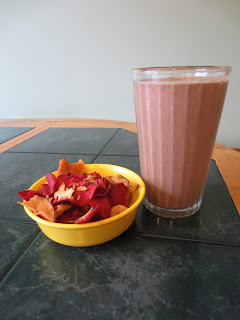
Our Fave Paleo Smoothie with Veggie Chips

Lunch
  • I often eat a deconstructed sandwich without the bread - turkey slices (or canned tuna or salmon) with lettuce, tomato, avocado, or whatever other veggies I have on hand.
  • Our favorite Chocolate Banana Smoothie - it works for breakfast, but we eat it more often for lunch. When my son comes home from college for lunch, I make a double-smoothie for us to share! I sometimes have veggie chips (like Terra brand) on the side for a bit of crunchy and salty (though they are not strictly Paleo due to the oils used).
  • Homemade soup - most store-bought soups contain rice or pasta or cream, but in the winter, I make a big pot of soup at the beginning of the week (some sort of meat with loads of veggies and broth) and have it for lunches.
  • Left-overs from dinner the night before. When it's just me at home for lunch, this is my usual go-to. I continue to cook for three, even though our youngest is now in college, and save the extra serving for lunch the next day.
  • Salads - the sky's the limit! Start with greens and pile on all the veggies you want, plus some protein and a vinaigrette made with olive oil. Some of my favorites include Cobb Salad (turkey, hard-boiled egg, bacon, tomatoes, cucumbers, and avocados) or Nicoise Salad (tuna, hard-boiled egg, lightly steamed green beans, tomato - I usually leave out the red potato).
Cobb Salad for Lunch or Dinner

Dinner
  • We often go simple and just sub a second vegetable for the starch in a typical dinner. So, grilled (or broiled or baked or...) meat or fish with two vegetables on the side (or a cooked vegetable and a salad).
  • Dinner Salads - we do this a lot in the summer, when we have lovely fresh lettuce and veggies from our local farm. See my favorites under lunch, but we eat lots of different salads. Our favorite dinner salad is a bed of lettuce with tomato, cucumber, carmelized onions, a small bit of blue cheese (yes, a cheat but it has almost no lactose in it), and sliced steak on top.
  • Homemade soup in the fall and winter.
  • Modified recipes: I still use some of my old favorite recipes, with slight modifications. We eat stir-fries and curries, just without the rice underneath (or with cauliflower "rice" instead). I might leave out breadcrumbs or cheese or other non-Paleo ingredients and add in extra veggies. I find that sources of healthy recipes, like Cooking Light magazine or Curtis Stone's cookbooks (both favorites of mine) are often naturally Paleo or can be easily modified.
  • Find Paleo substitutes for your favorites, like cauliflower rice for rice (recipes in the Paleo cookbooks below) or zucchini noodles made with a spiralizer instead of pasta.
  • Paleo recipes. See below for suggestions and links.
Ground Beef and Cabbage Soup for Dinner with Left-overs for Lunch

 Snacks
  • Nuts and seeds - lots of protein and portable, though they should be limited if you are trying to reduce inflammation or avoid oxalates. Pistachios and macadamia nuts are lowest in oxalates. Be sure to get salted nuts to help with OI!
  • KIND bars with 5g of sugar - they make several varieties now that are low in sugar. Our favorite is the Dark Chocolate Sea Salt. Still a bit too much sugar for me, but they come in handy when traveling. They are mostly made with nuts, so the same comments above apply. There are other brands of Paleo snack bars available now--just read the labels to make sure you aren;t allergic or sensitive to any of the ingredients.
  • Coconut yogurt (unsweetened) with fresh fruit. I just discovered yogurt made from coconut milk, and I was thrilled! So Delicious brand makes several unsweetened varieties. I cook with the plain and have the vanilla flavor for snacks. The downside is that it doesn't have the high protein that yogurt made from milk does.
  • Apple or pear and sunflower butter or nut butter. One of my favorite snacks this time of year especially: I cut up an apple and dip it in a tablespoon of sunflower butter - yum!
  • Jerky - there are lots of different varieties, including turkey and salmon. Trader Joe's has a great selection. Look for a brand with no nitrates and low or no sugar.
  • Veggie chips, like Terra brand, can satisfy the desire for crunchy, salty snacks (I found that Target has the best prices, though Amazon is a close second).
  • Although legumes are not strictly Paleo, I occasionally have a bit of hummus with raw veggies. 
  • A friend suggested toasted nori (seaweed) - I need to try that.
  • Extra-dark chocolate (86% cacao or higher) - yes, you can eat chocolate! Use raw cacao powder in baking and smoothies. I sometimes use unsweetened baking chocolate in recipes or to make a simple chocolate sauce (with stevia). And I eat a square of dark chocolate every night with my herbal tea - just choose 86% or higher cacao (there is less than a gram of sugar per square in it). My favorite is Ghiradelli Intense Dark 86%. Bonus: Dark Chocolate is one of the best anti-inflammatories in the world! It also contains iron, magnesium, and zinc, so as long as it's dark (i.e. less sugar and more cacao content), then it's actually very nutritious!
My evening treat: herbal tea and extra-dark chocolate

Paleo Recipe Resources

Two of my favorite Paleo cookbooks are Everyday Paleo and Against All Grain (links are to my own reviews for details). These cookbooks include many Paleo versions of favorite foods, including breads and desserts (see my reviews for lists). I also love Everyday Paleo: Thai Cuisine and use it almost every week (but I haven't reviewed it yet). I have also found lots of recipes that are naturally Paleo or easily modified in Curtis Stone's What's for Dinner?

Two Favorite Cookbooks: One Regular and One Paleo
There are LOTS and LOTS of blogs and websites devoted to a Paleo diet with loads of recipes. One I use is Against All Grain, but there are many others, too. Whatever recipe you are looking for, just type it into your search engine with Paleo, and you will probably get lots of results.

Curtis Stone's Squash Curry - So Good!

Some of my own Paleo recipes:
My Dark Chocolate Bark
Eating this way has helped both my son and I quite a bit. It has helped us to get our yeast overgrowth under control (along with other approaches), helped to improve methylation, and reduced GI symptoms (eliminating dairy 12 years ago completely eliminated my GI problems!). Many people also find they lose weight on a Paleo diet, due to getting rid of refined carbs, flour, and most sugar and eating more vegetables.

I hope that will answer some of your questions and get you started on your own healthy eating plan. This was a long post, but I'm sure there are things I've forgotten, so please leave any questions or comments in the Comments below, and I will be happy to answer.

-->Note: This post contains affiliate links. Purchases from these links provide a small commission to me (pennies per purchase), to help offset the time I spend writing for this blog, at no extra cost to you.
   .    .    .      .    .    .    .